
CUSTOMS.
MADE CLEAR.
Sending internationally means providing the right customs information and understanding when duties or taxes may apply. Twyft guides you through what we need for the shipment and explains what happens next.
Isle of Man → United Kingdom
USUALLY STRAIGHTFORWARD.
The Isle of Man and United Kingdom operate within a shared customs and VAT framework. For most ordinary goods, an IOM-to-UK parcel does not go through the same import-customs process as a shipment to a destination outside that area. Controlled, restricted or specialist goods can still have additional requirements.
Sending Internationally
WHAT WE NEED FROM YOU.
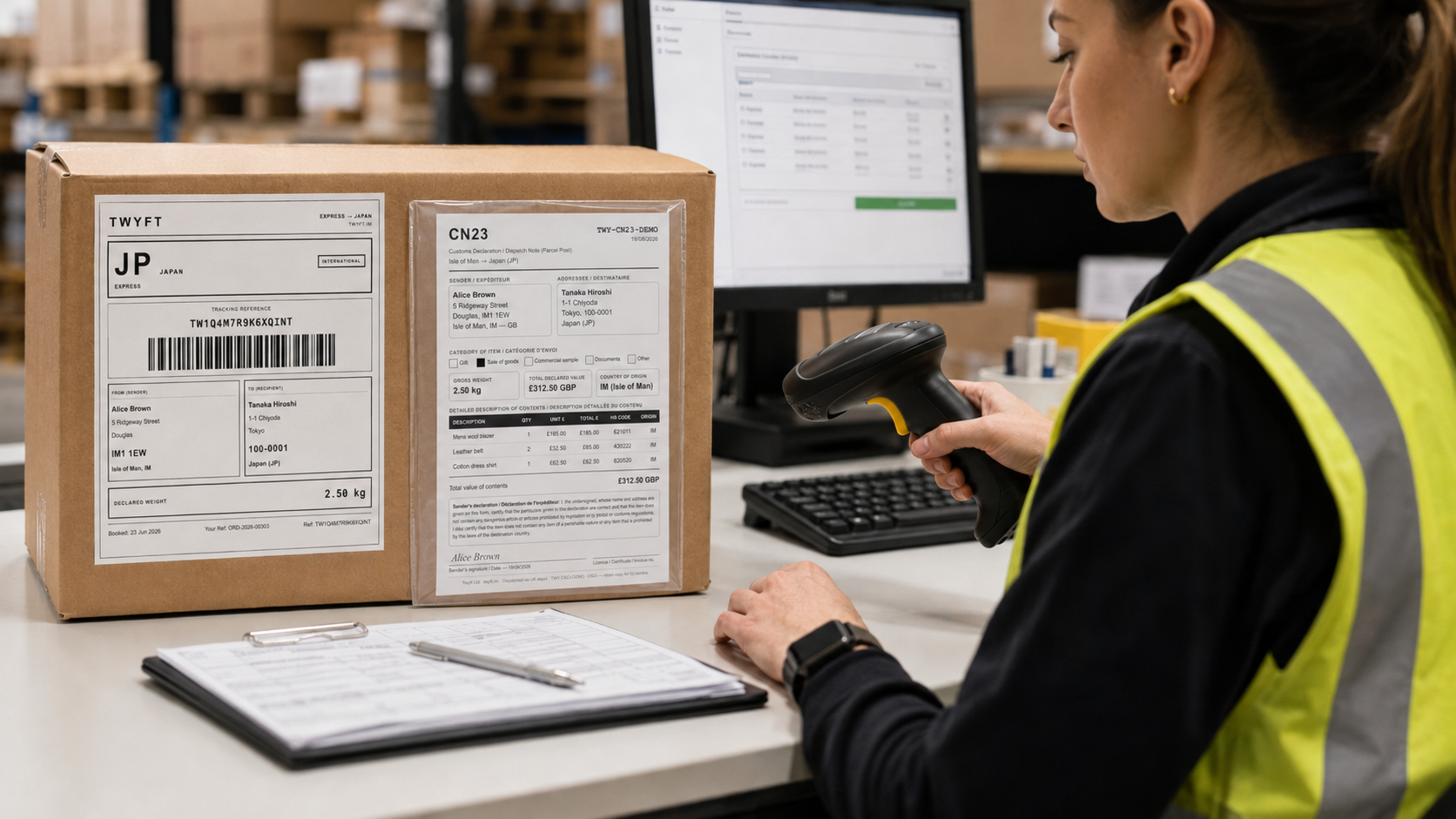
Good customs data starts with accurate booking information. The clearer the information you provide, the better prepared the shipment is for its destination.
What is inside
Use a clear, specific description rather than vague terms such as “gift”, “parts” or “samples”.
Quantity
Tell us how many of each item are in the parcel.
Accurate value
Declare the genuine value of the contents. Customs authorities may use it when assessing the import.
Reason for export
For example sale of goods, gift, return, sample or another applicable reason.
Country of origin
Where required, tell us where the goods were manufactured or produced.
Recipient contact details
Provide the correct recipient name, address, email and a reachable mobile number.
Recipient details matter
MAKE SURE THEY CAN BE REACHED.
If duties, taxes or clearance information are required after dispatch, the final mile delivery partner may need to contact your recipient. A correct mobile number helps any payment or clearance request reach them promptly — and once the required charges or information are dealt with, the shipment can continue without avoidable delay.
The customs journey
WHAT HAPPENS NEXT.
You provide accurate information
Your booking gives us the contents, value, quantity, destination and recipient information needed for the shipment.
Twyft prepares the shipment data
We use the information you provide to prepare or transmit the shipping and customs data required for the selected service.
The destination processes the import
Destination authorities and the relevant delivery process assess the shipment, including any duties, taxes, inspections or additional clearance requirements.
Duties & taxes
WHO PAYS?
The answer depends on the service and how the shipment is arranged. Twyft’s normal international booking journey is recipient-paid for many standard services.
RECIPIENT-PAID
This is the normal position for many standard Twyft international bookings. Duties and taxes are not collected during the Twyft booking flow.
If import charges are assessed, the recipient may be contacted by the final mile delivery partner or destination process and asked to deal with them before the shipment can continue.
SENDER-PAID / DDP
For some shipments it may be possible to arrange duties and taxes so they are handled by the sender instead.
Availability depends on the destination, service and how the shipment is arranged. DDP is not currently available through every standard Twyft booking route.
Want the sender to handle the charges? Talk to us.Current rules to know
IMPORT RULES CHANGE.
These are current headline changes that may affect international shipments. The final assessment always depends on the goods, destination and rules in force when the shipment is imported.
From 1 July 2026
European Union
The previous €150 customs-duty exemption for qualifying low-value distance-sale imports was replaced by a temporary €3 customs duty linked to tariff classification. VAT remains separate. The temporary measure is due to run until 1 July 2028.
Source authority: European Commission
From 29 August 2025
United States
The general $800 de minimis treatment ceased to be available for covered commercial shipments from all countries. Duties, taxes or other import charges may therefore apply even to lower-value commercial shipments.
Source authority: U.S. Customs and Border Protection
Business shipping internationally
MORE COMPLEX? TALK TO US.
Commercial invoices, IOSS, regular export volumes and sender-paid duty arrangements can create additional requirements. If your business ships internationally on a recurring basis, we can discuss the operating model rather than forcing every scenario into a consumer parcel guide.
Talk to TwyftCommercial invoices
Some destinations and shipment values require additional commercial documentation.
IOSS
Relevant to some businesses selling eligible low-value goods to EU consumers; it concerns VAT rather than customs duty.
Recipient communication
Accurate recipient email and mobile details matter when import action is required.
Sender-paid options
Where appropriate, ask us whether a sender-paid arrangement can be supported for the shipment.
Common questions
CUSTOMS FAQs.
READY TO SEND INTERNATIONALLY?
Start with the shipment details. We’ll guide you through the information needed for the service you choose.
Explore International Delivery